




Introduction
Slab is always the first step when we are discussing solid construction. Prior to the casting of the slab, shuttering should be properly verified. Many people ignore this step. They are later met with cracks, leakage and uneven slabs. It is our belief that at Quartier Studio, being ranked amongst the Best interior designers in Delhi NCR and also one of the reliable Architecture Firms In Delhi, good design begins with good structure.
All projects are dealt with technically, under the supervision of Suhel Akhtar, Director and Architect, and Raja Anuj Anand, Founder and Director. Under either Home Renovation In Delhi or complete architectural planning, it is necessary to check shuttering prior to casting the slab as a precaution to avoid unsafe and unsound construction.
About the Slab Cast and Shuttering

The framework under the slab until the time when concrete is poured is referred to as shuttering. It upholds the wet concrete until it gets strong. Once the slab casting is done, and concrete strengthening has taken place, the shuttering can be removed.
Unless the slab has strong shuttering, the slab will not be strong. Water may leak. Steel may get exposed. The slab may not be level. That is the reason why professional Interior design companies in Noida and the Top Architecture Firms In India, never cast without following the correct site check.
At Quartier Studio, we use structure as the support of any interior design work. A Noida-based beautiful interior design firm understands that beautiful finishing begins with good structure. Quartier Studio Suggestion: Never approve slab casting without first taking a good inspection of the shuttering.
Importance of Checking the Shuttering
It is not a small task to check shuttering. It has a direct influence on the safety, durability, and finishing quality. Certainly, the interior designer in Noida can never do anything about structural damage in the future if the base is incorrect.
In the event of it being improperly taped shut, there is slurry and water leakage at the bottom during slab casting. This reduces slab strength. When there are no cover blocks, steel bars are visible after taking off the shuttering. Unless reinforcement bends are properly performed, beams lose their strength.
Site supervision is very strict at Quartier Studio, one of the Best interior designer teams in Noida. A check is carried out on the structure before slab casting to prevent the cost of repair in the future. Quartier Studio Recommendation: There should never be haste in slab casting. Qualified inspection conserves time and money.
How to Check Shuttering Before Slab Casting – Detailed Explanation
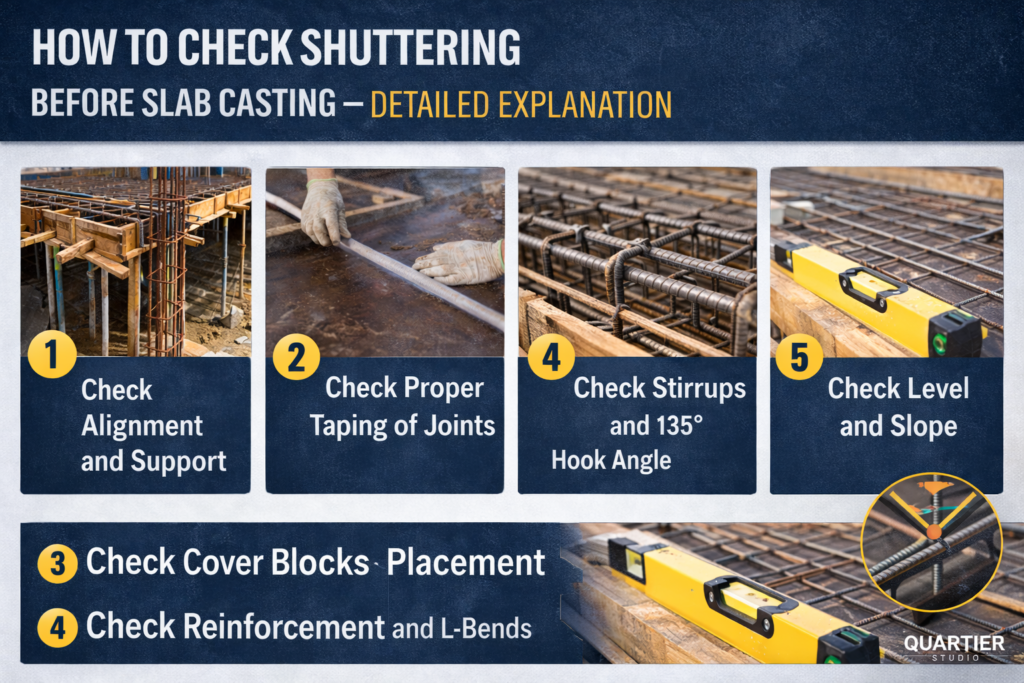
- Shuttering inspection is one of the most important site works before any slab is cast.
- A large number of structural failures, cracks, leakage issues, and loose ceilings occur due to the absence of a proper check of shuttering.
- Support is temporary support. But its impact is permanent. In case shuttering fails during the casting, the concrete can bulge, leaked or collapse.
- Small errors can diminish slab strength and durability even in the event that it does not collapse.
We should analyze each check in every detail
1. Shuttering Joints should be well taped.
The concrete that poured down is not solid. It consists of cement paste, water and fine materials. This solution is referred to as a slurry.
Where there are small spaces between shuttering boards:
- Slurry leaks out.
- The content of cement is minimized within the slab.
- Honeycombing occurs.
- Surface becomes weak.
- Edges become rough.
- It is the reason why we do taping at joints.
What to Check in Detail:
- All the joints between the plywood sheets should be covered.
- Meetings of beams and slabs at the corners should be inspected.
- It should not say there is any gap line.
- You must not look through the joints in the daytime.
- Tapes are to be pressed and attached and should not be loose.
- In case of leaking slurry, strength decreases. This impacts long-term durability.
2. Checking Cover Blocks properly
Cover blocks are tiny concrete blocks in between steel reinforcements and shuttering surfaces. They do not reduce the proper thickness of the concrete cover.
1. Covering prevents steel bars against the following:
- Corrosion
- Moisture
- Fire
- External damage
2. If cover blocks are missing:
- Shutting may be in contact with steel bars.
- Rebar can be exposed after the removal of the shuttering.
- Rusting starts early.
- Structural life reduces.
3. What to Check in Detail:
- Appropriate size block cover is applied (in accordance with design).
- Blocks are arranged in adequate spacing.
- No broken or cracked cover blocks.
- The lifting of steel bars is done at the bottom.
- The whole slab is covered.
- A minor error in this case can decrease the lifespan of the structure.
3. Reinforcement and L-Bend Inspection
The support of slab strength is reinforcement. Tensile loads are taken on steel bars. Concrete assumes a compressive load.
The L bend offered in beam reinforcement is one of them.
1. These bends:
- Anchor the beam properly.
- Provide load transfer.
- Prevent slippage
- Increase beam stability.
- If L-bends are not proper,
- Beam may lose bonding.
- Weaknesses in the structure can arise.
- Junctions of beams can have cracks.
2. What to Check:
- L-bend length is a structural drawing.
- Angle is properly bent.
- Where a bend is needed, it is not done in straight-line bars.
- Binding wire tying is tight.
- No precast displacement of bars.
Never use reinforcement layout without checking against authorized drawings.
4. Stirrups (Rings) and a 135degrees Hook Angle.
Stirrups are circlets that are fitted around beam bars. They have the primary reinforcement in their hands.
The angle of the stirrup hook is very critical. Correct angle: 135 degrees
1. Why 135°? Because
- It offers enhanced anchorage.
- Deters opening of stirrup when loaded.
- Enhances resistance to earthquakes.
- Enhances shear strength of beams.
When the angle is 90 deg, then that is structurally unsafe in most cases.
2. What to Check:
- Physically measure the angle of the hook.
- Make sure that all the stirrups are the same.
- Separating is equivalent to structural drawing.
- No missing stirrup.
- Proper tying at every joint.
This is a minor fact but extremely important in the field of structural engineering.
5. Shuttering Level Check
1. Level checking does not only consider appearance. It affects:
- Flooring finish
- Ceiling alignment
- Water slope
- Door height
- False ceiling work
2. If the slab is uneven:
- There is a need for an additional plaster thickness.
- There is a slope to the flooring.
- Water can be concentrated in the incorrect regions.
- There is a rise in interior work costs.
3. What to Check:
- Make use of a level or laser level.
- Check C2C alignment.
- Ensure that there is the necessary slope in the bathroom rooms.
- Inspect prop support.
- Check for sagging of plywood sheets.
- Always ensure a final check before pouring concrete.
6. Additional Structural Checks (Advanced Level)
To improve the quality of structure, also inspect:
1. Support and Props
- Props must be vertical.
- Base plate must be stable.
- No loose or tilted supports.
- Sufficient distance between supports.
2. Shuttering Oil Application
- Shuttering oils are used properly.
- Not excessive oil.
- Pouring after cleaning the surface.
3. Cleanliness
- Remove debris.
- Remove wood chips.
- Remove loose binding wires.
- Clean shuttering is a method of enhancing bonding and finish quality.
What Will Happen When You do not do these Checks?
If shuttering inspection is ignored:
- Slab thickness may vary.
- Cracks may develop early.
- Leakage from slab.
- The cost of structural repair goes up.
- Ceiling alignment problems.
- Reduced life of building.
The overwhelming majority of long-term structural issues begin with negligence on the small scale.
Why Professional Supervision Matters
Pouring concrete is not the only thing in slab casting. It is about:
- Technical accuracy
- Structural understanding
- Site supervision
- Drawing compliance
- Quality control
These little but significant details are known to experienced architects and structural supervisors.
They check:
- Reinforcement
- Level
- Structural anchoring
- Concrete mix design
- Proper curing plan
Why is a quartier Studio the best place to be when it comes to structural and interior perfection?

Quartier studio is one of the Best interior designers in Delhi NCR and one of the best Interior Design Companies In India. Under the leadership of the Founder and Director Raja Anuj Anand and Suhel Akhtar, a Director and Architect respectively, the firm integrates the power of structure and the art of design.
Being a reputable Noida-based Interior company and one of the reputable Top Architecture Firms In India, Quartier Studio will make certain that site inspection is done properly before slab casting. They are technical, durable and safety-oriented.
In case you are seeking the Best interior designer in Noida or good Interior design companies in Noida in Home Renovation In Delhi, Quartier Studio offers the complete solution—structural oversight to final interior decoration.
Conclusion
Slab casting is a very important construction process. Once cast concrete is laid, it becomes hard to make corrections. This is the reason why the inspection of shutters should be taken with caution.
Check taping, cover block, reinforcement bends, shuttering level and stirrup hook. Every action suffices for safety and endurance.
Quartier Studio has very high standards in structure under the leadership of Raja Anuj Anand and Suhel Akhtar. This is the reason why they are considered to be the Best interior designers in Delhi and a trusted Architecture Firm In Delhi. A solid slab is insurance for a safe home. Never skip inspection.
FAQs
What is the importance of shuttering inspection prior to the casting of slabs?
It guarantees power, security and adequate completion of the slab.
What would be the proper hook angle of stirrups?
A 135 degree angle is the correct hook angle.
What would occur when there are no cover blocks?
The reinforcement of steel can be exposed and corroded.
How is slab level checked?
With a water level or other laser leveling tool.
Who leads Quartier Studio?
The Founder and Director is Raja Anuj Anand; the Director and Architect is Suhel Akhtar.